Wall Painting Designs To Give A Rich Look To Transform Your Home
Wall Painting Designs To Give A Rich Look To Transform Your Home
Published: 08 Feb 2021 |
Modified: 17 Aug 2026
HomeWall Paint
Wall Painting Designs To Give A Rich Look To Transform Your Home
Quick Summary
Wall painting designs can transform plain walls into attractive focal points using texture, stencils, stripes and two-tone colour schemes. The right wall paint design ideas should complement the room’s size, lighting, furniture and existing colour palette. Textured finishes add depth, stencils create patterns, stripes influence visual proportions, and dual-tone combinations introduce contrast while keeping the overall design balanced.
Create Your Dream Home With Our Painting Experts
Fill the form below to book a free site evaluation by Nerolac Nxtgen painting Services expert
TABLE OF CONTENTS
Rich-looking, insta-worthy homes are made all about choosing the right wall paint colours, decorating with unusual elements, and keeping them clean. But when you move away from plain walls and try various wall painting design patterns and styles, the beauty of your home is doubled. This piece will share some easy yet artistic ways to give your home a dash of richness and style.
Try Our Suggestions For Wall Painting Designs
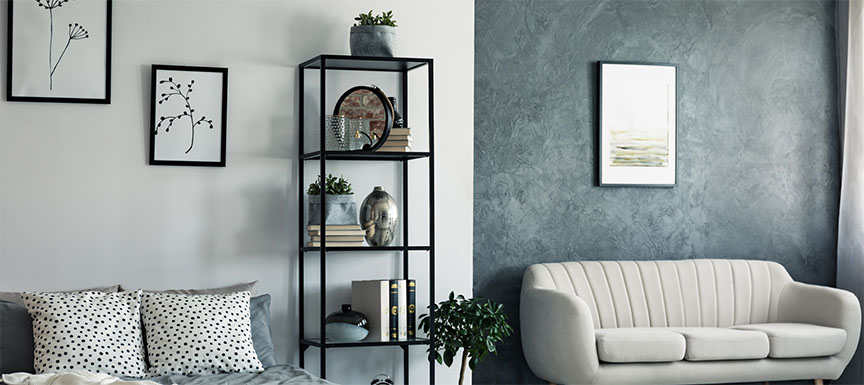
Add Some Texture with Wall Painting Designs
Add Some Texture with Wall Painting Designs
Four plain walls are the style of 2020! It's now time to add at least one wall that screams style. The world is full of amazing wall painting design patterns and textures that you can do on your own or hire master painters for. Textured walls add depth to your rooms that most simple walls cannot. The shapes, variations of colours, and illusions created with textures are enough to spice up your entire room. If you look at our DIY videos, you'll see that you can create artistic patterns using simple tools like a comb, string, sponge, and plastic bag. So choose your style soon.
Do The Stencil-Work To Your Wall Painting Designs
While textures require precision, stencil work is an easier way to play with plain walls and add some design. You'll find countless stencils in the market available in various sizes and designs. All you have to do is place them accurately on a painted wall and dab in some colour. Remove the stencil only when the paint is semi-dry and see how lovely your walls will look. If you don't find a nice stencil in the market, you can create one of your own on a thick plastic sheet. The sky’s the limit when it comes to dressing up your home walls with stencil wall painting designs.
Experiment with Stripes in Your Wall Painting Designs
Experiment with Stripes in Your Wall Painting Designs
Stack two or more straight lines, and you have the most artistic wall painting designs for halls, bedrooms, and balconies. Strippy walls are clean, easy on the eyes, and infinitely variable. Perhaps that’s why the most common patterns used to decorate interior walls are stripes in all their glorious variations. They can be horizontal, vertical, one stripe, lots of stripes, jagged stripes, colourful stripes. Choose your pattern, choose your colours, and add just-the-right impact on your home walls.
Explore Duo Wall Painting Designs
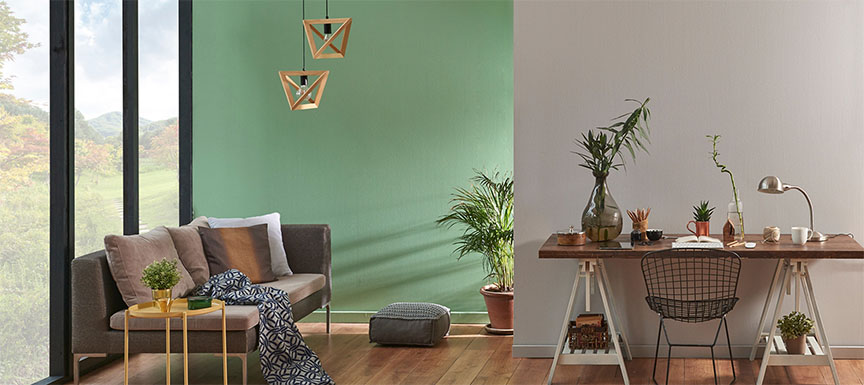
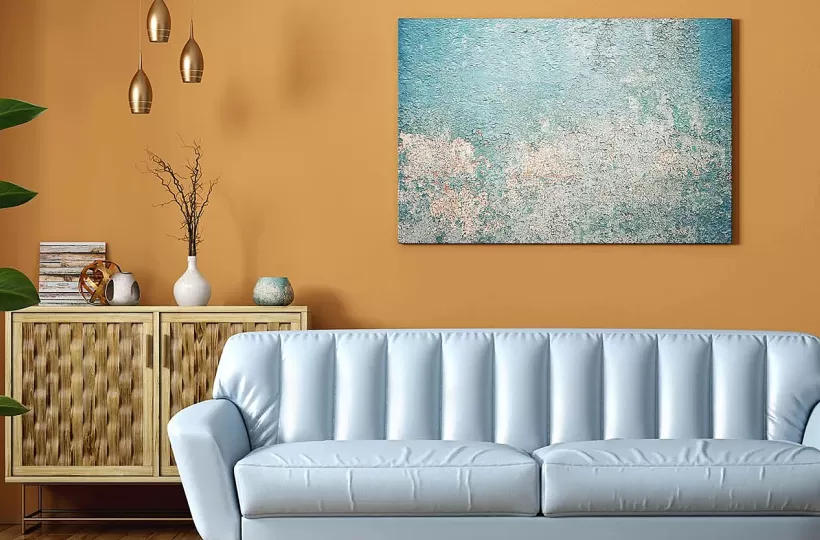
Don't wish to experiment with wall paint design patterns and textures? Simply add more colours to space! This idea is simple, but you need the right sense of colours to bring beauty to your rooms. Look at the latest wall painting design online or pick your favourite colours and follow the dual-tone colour scheme for your bedrooms and living room. Create a perfect balance of dark and light in your rooms so they don't look overwhelmingly muted or overpowered by colours. Want more wall painting design ideas for your home? Talk to our master painters, and they will share countless possibilities to switch to a richer look for your home.
Key Takeaways
Wall painting designs can add depth, personality and visual interest to plain walls.
Textured wall designs create dimension and can become a focal point in a room.
Stencil patterns offer a simple way to introduce decorative designs without extensive renovation.
Vertical, horizontal and varied stripe patterns can change how the proportions of a room are perceived.
Two-tone wall painting designs create contrast by combining complementary light and dark shades.
Choose a wall paint design according to the room’s size, lighting, furniture, colour palette and overall décor style.
Nerolac Paints, a leading paint company in India offers a wide range of wall paint colours & painting services & solutions for homes & offices.
Best Colour Combination For Walls To Elevate Your Home Interiors
Looking for something else? Drop your query and we will contact you.
FAQs
Which wall painting design is best for a small room?
+
For a small room, choose wall painting designs that create visual openness rather than making the walls appear crowded. Light two-tone combinations, subtle vertical stripes, soft geometric patterns and restrained textures can work well. If you want a stronger design, consider limiting it to one focal wall while keeping the remaining walls in a lighter, coordinated shade. Always test the colours under the room's actual lighting before painting the complete wall.
How do I choose wall paint colours for a painting design?
+
Start with the room's existing furniture, flooring, curtains and décor. Select a dominant wall colour and then choose one complementary or contrasting shade for the design. For example, a neutral base can support a stronger geometric or striped pattern, while colourful furniture may work better with a restrained wall palette. Consider natural and artificial lighting because the same paint colour can appear different throughout the day.
Which wall painting designs make a room look taller?
+
Vertical wall painting designs can draw the eye upward and create the perception of greater height. Vertical stripes, elongated geometric patterns and painted panels are useful options. Keeping the ceiling lighter than the walls can further reinforce the effect. For a more subtle approach, use two closely related shades rather than highly contrasting colours, particularly if the room already contains several decorative elements.
How can I create a modern wall paint design without making the room look busy?
+
Use a limited colour palette and repeat simple shapes rather than combining several unrelated patterns. Geometric colour blocking, understated stripes, a two-tone wall or a single textured finish can create a modern appearance while maintaining visual balance. Keep surrounding furniture and décor relatively simple so the wall remains the primary feature. Matte or low-sheen finishes can also create a more understated contemporary appearance.
What wall painting designs work well behind a TV or sofa?
+
A wall behind a TV or sofa can work as a natural focal point. Consider a two-tone design, subtle texture, geometric colour blocking or a deeper shade that contrasts with the surrounding walls. For TV walls, avoid overly busy patterns that could compete visually with the screen. Behind a sofa, you have more flexibility to use artwork-inspired patterns, stripes or decorative paint techniques.
How do I maintain decorative wall painting designs?
+
Maintenance depends on the paint and finish used, but regular dusting and gentle cleaning can help decorative walls retain their appearance. Avoid abrasive cleaning materials that could damage painted patterns or textured surfaces. Keep touch-up paint from the original project where possible, especially when multiple colours are used. For high-touch areas, choose a suitable washable finish and address stains or scuffs promptly.
You will be redirected to a webpage/domain hosted by a third-party service provider (“Service Provider”) for limited purposes related to your interaction with Kansai Nerolac Paints.
Please note that while the Company’s logo may appear on the Service Provider’s page, it is not a Company-controlled page and is operated independently by the Service Provider.
On the Service Provider’s page, you will be provided with options for submitting your data, including uploading documents or providing information through various means.
While these options are enabled through a service provider, the Company does not endorse any specific option, and you are requested to choose independently and at your sole discretion.
Any actions taken on the Service Provider’s page, including the submission of data, shall be a matter between you and the Service Provider, and the Company will not be a party to this relationship.
You are responsible for the consent you provide on the Service Provider’s page, and any acceptance of terms beyond the purpose of use by the Company shall be deemed a contract between you and the Service Provider.
By providing your data through any of the available modes, you agree to share and disclose your information with the Company and the Service Provider for the purposes outlined above.
The Company may process, retain, and use the information as per its discretion.
For any modification, correction or erasure of the provided information, please raise you request by sending an email to dataprivacy@nerolac.com
Consent
In this Consent the following capitalized terms shall have the meanings assigned to them hereunder: By 'personal information' we mean names, addresses, email addresses, job experience and history and any other personal information you voluntarily provide about you and your skills and interests .“Data” shall mean all personal data, transactional data, Derivative Data, any other information, etc., in relation to me/us, including the following in relation to past Products:
By providing the consent you agree to providing your personal data which can be used by KNPL for the purposes mentioned hereafter and confirm that this consent is being given freely by you without any pressure, influence, or coercion from any other person, and that the consent is informed and unconditional.
Information submitted while making any application or request to the KNPL for any Product. Collection of information from personal correspondence (emails, letters) or third-party communications related to user activities on the website. Information may be used to offer products/services from the company and joint sponsors. Communicate with customers about orders, products, services, and promotional offers. Enhance and personalize the shopping and viewing experience on the website.
Additional information collected during transactions includes billing address, payment instrument details, and tracking information, handling orders, delivering products/services, and processing payments.
Information from messages or feedback provided by users is collected and retained for dispute resolution and customer support.
any information obtained/received by KNPL from any other source.
Collection of demographic and other data for advertising and promotional purposes. It can be used to show relevant content and customer reviews, suggest merchandise and services of interest, Improve the website and prevent/detect fraud or abuse, enable third parties to perform technical or logistical functions on behalf of the company.
We may share your personal information with vendors or service providers such as companies who help us with database administration. We may also share your personal information with other Kansai Nerolac companies in other countries where data privacy laws may not be equivalent to those in force in India.
any Derivative Data.
DEFINITIONS
“Derivative Data” shall mean any insights, analytics, performance metrics, behavioural projections, customer profiling, and reports (prepared by the Company internally or by third parties) that are generated through the analysis of data collected from customers, sales transactions, market research, and other relevant sources. This includes, but is not limited to, colour preference trends, purchase frequency, customer demographics, product usage patterns, and feedback analysis. Derivative Data may also include predictive analytics regarding future buying behaviour, inventory optimization, and market demand forecasts, whether derived from the information collected from customers or in combination with any other information sourced from external databases, market research firms, or other entities, whether by the Company or other persons. The process of arriving at and generating such Derivative Data through any of the above sub-processes/methods shall be referred to as “Derivation”.
“Specified Purposes” shall collectively mean the collection of personal data for various essential functions, including customer identification and verification to ensure eligibility for services or promotions, processing and fulfilling orders accurately, and enhancing customer engagement through tailored marketing campaigns and personalized offers. The data will also be utilized for monitoring sales trends and inventory management to optimize stock availability, providing customer support and service to address inquiries and resolve issues, and gathering feedback for product improvement and innovation. Additionally, the company will conduct market research and analysis to understand trends and customer preferences, implement risk assessment measures to detect and prevent fraud, and ensure compliance with legal obligations, including data protection and consumer rights. Personal data will support the management of loyalty programs and promotions, enhance the digital experience on the website through personalization, and facilitate data sharing with third-party partners for operational efficiency. Furthermore, the company will collect data for sustainability and environmental reporting, engage in necessary legal and regulatory compliance activities, and utilize analytics to monitor website performance and overall business effectiveness. aggregators, payment gateways, payments systems, performance of any legal and/or regulatory obligations, filings, reporting, etc., whether any of these are undertaken internally or through any Processing Entity.
"Processing” shall mean any operation or set of operations performed on Data, and includes operations such as collection, recording, organisation, structuring, storage, adaptation, retrieval, use, alignment or combination, indexing, sharing, disclosure by transmission, dissemination or otherwise making available, restriction, erasure or destruction and the term “Process” and “Processed” shall be construed accordingly.
“Processing Entity” shall mean any third party company(ies), bureau(s), consultant(s), vendor(s), agent(s), fintech entity(ies), co-brand entity(ies)/partner(s), distributor(s), selling/ marketing agent(s), any partner(s), collaborator(s), merchant(s), aggregator(s), lead generator(s), sourcing entity(ies), client(s), customer(s) or other person(s) with whom the KNPL has any direct or indirect arrangement or tie-up or contract for any products or services/ intermediary(ies) in any ecosystem of which KNPL is a part, and such Processing Entities’ service providers, consultants, vendors, etc.
“Product(s)” shall mean all types of paint and related products offered by the Company, including but not limited to topcoat, under coat, interior and exterior paints, primers, sealants, varnishes, specialty coatings, tools and ancillaries, wood finishes and construction chemicals. This definition encompasses products sold directly through the Company’s online platform, as well as those distributed through authorized dealers, retailers, contractors or other third-party vendors. The Products may also include complementary items such as paintbrushes, rollers, paint trays, and other application tools, as well as services related to colour consultation, custom mixing, and professional painting services. The Products that have been applied for, requested, or purchased by me/us (including where the initiation of any transaction is not directly with the Company but is with a relevant distributor or retailer) shall be referred to as “Requested Products,” while any Products (including future offerings) other than the Requested Products shall be referred to as “Other Products.”
CONSENT
I hereby authorize Kansai Nerolac Paints Limited (“Company”) to process my personal data (“Data”) or any part thereof for any of the Specified Purposes:
SPECIFIED PURPOSE
In connection with the assessment or processing of my application/request for any Requested Product, or to take any steps prior to entering into any contract, or to determine eligibility for the Requested Products, or in connection with the execution or furtherance of a contract/transaction, including performance by the Company or me/us or any other intermediaries, of any contract or part thereof, or any regulatory or legal obligations in relation to any Requested Product availed or in pursuance thereof;
In connection with the derivation and sharing of any derivative data (between the Company and any processing entity) related to the purposes.
In connection with contacting me, establishing communication, and monitoring my interactions through email, postal address, telephone, social media, notifications, and other electronic.
PURPOSES
I authorize the Processing Entities to process my Data or any part thereof for any of the Specified Purposes.
For the purposes covered above, it shall be deemed that I have furnished all the Data separately under this consent.
I confirm that the Data provided and that will be provided by me from time to time is accurate, updated, and complete in all respects.
I agree that the consents/authorizations for the Specified Purposes shall survive beyond the validity of such application/tenure of the Product/consummation of any transaction, to the extent any of the Specified Purposes survive.
The consents given or denied under this document do not limit any other consents obtained or given.
I acknowledge and confirm that all the Specified Purposes are lawful purposes.
I understand and agree that the processing of Data is necessary for the Specified Purposes.
I acknowledge that the request for consent or my giving of this consent does not limit or prejudice any grounds or bases that the Company or any Processing Entities may have for processing the Data without consent. This consent is in addition to any such grounds or bases. For clarity, even if this consent is withdrawn, the Company and/or the Processing Entities may continue to process the Data for the performance of contracts related to the Requested Products or for taking any steps pursuant to the contract or for protecting the legitimate interests of the Company.
I acknowledge that since this consent is the basis for the Company to enter a contract related to the Requested Products, it is necessary to process the Data for the purposes of the contract. Withdrawal of this consent will not prevent the Company and/or Processing Entities from continuing to process the Data for the purposes of the contract.














 Get in Touch
 Download App
