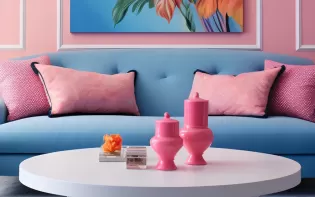
Blue is the colour of open skies on unhurried mornings, of deep water that makes you stop and look, of that one room you walked into and immediately felt at ease in without knowing why. The colour blue is calming, clarifying, making spaces feel larger and more spacious than they actually are.
It's also one of the most practical choices for a home. Unlike some colours that work only in specific rooms or lighting conditions, blue colour adjusts comfortably across the whole house. A soft powder blue colour in a nursery, a deep navy in a living room, a washed-out denim tone in a kitchen that gets good afternoon light - each version of blue carries a different feel, texture and a different mood.
What makes blue interesting to work with is precisely that range. Understanding even the basics of how blue behaves, such as how it shifts with light, how adding white or black changes its entire personality, helps you make better choices. Whether you're planning to mix the paints yourself or picking from a catalogue, the right guidance will be useful.
Blue Colour Composition
Blue is one of the three primary colours, which means it stands on its own; it can't be produced by mixing other colours. What it can do is serve as a base for an enormous range of variations. Every blue shade you see, from the palest ice blue to the deepest midnight navy, starts from this single primary and builds outward from there.
What Colours Make Blue?
- Since blue is a primary colour, the more useful question is what you can make from blue rather than what makes it. Blue appears opposite to orange colour on the colour wheel, making orange its complementary colour.
- This matters when you're trying to mute or neutralise a blue tone - a small touch of orange will do that faster than almost anything else.
- On its own, blue is the starting point. Mixed with white, it lightens; with black, it deepens; with green colour, it moves toward teal; with a trace of red, it shifts toward violet colour or indigo.
- Each addition changes both the colour and the emotional quality of the shade, which is what gives blue its remarkable versatility across different spaces and styles.
How to Make Blue Colour?
Blue itself can't be mixed from scratch - it's a primary tone. But creating specific blue shades and tones from a blue base is straightforward once you know the approach.
- Start with a pure, clean blue base - The quality of your starting blue determines the quality of every variation you make from it; a dull or slightly greenish blue will carry that quality through into your final shade.
- Decide on your target tone first - Knowing whether you want a light, dark, warm, or cool blue before you start prevents unnecessary back-and-forth.
- Add modifying colours in very small amounts - Blue is reactive; a little white, black, or green goes further than you would expect.
- Mix thoroughly before assessing - Streaky or partially mixed paint gives a false reading; always blend completely before deciding whether to add more.
What Two Colours Make Blue Colour?
While pure blue can't be mixed, combining blue with other colours creates distinct variations. Here's how different pairings behave:
|
Complementary Pair
|
Tone Produced
|
|
Blue + White
|
Soft, airy light blue or sky tone
|
|
Blue + Black
|
Deep, dramatic dark blue or navy
|
|
Blue + Green
|
Fresh teal or aqua blue
|
|
Blue + Grey
|
Muted, sophisticated slate blue
|
|
Blue + Violet/Purple
|
Rich indigo or blue-purple tone
|
Also Read: 14 Colour Combinations with Blue for Home
How to Make Blue Colour by Mixing Two Colours?
For blue-based mixes, the ratio between blue and its modifying colour determines both depth and warmth.
|
Ratio (Blue: Modifier)
|
Dominant Colour
|
Result
|
|
90:10
|
Blue dominant
|
Slightly shifted base blue - subtle change
|
|
80:20
|
Blue dominant
|
Noticeable variation; lighter, darker, or tinted
|
|
50:50
|
Equal parts
|
Full blend - teal, indigo, or grey-blue, depending on the modifier
|
How to Make Light Blue Colour?
Light blue colour comes from adding white to your base blue - gradually, not all at once. The pace matters. Add white in small increments, mix fully, hold the result up to the wall and assess in natural light before deciding to add more. A common mistake is overshooting - adding too much white too quickly and ending up with something that reads more white-with-a-hint-of-blue than an actual light blue.
How to Make Dark Blue Colour?
Dark blue colours are some of the most striking choices for interior walls - but they need careful handling. Add black to your blue base in very small quantities, mixing completely between each addition.
- Pacific Bay - A deep, oceanic blue with real richness.
- Greek Lake - Blue with a Mediterranean warmth to it.
- Splish Splash - Darker than a mid-blue but with a lively quality.
- Ocean Road - A true deep blue with coastal associations.
How to Adjust Blue Colour Tone?
A base blue can be steered in three meaningful directions once you have it mixed, and each produces a noticeably different result on the wall.
- Warm blue - Add a very small touch of red or a trace of yellow colour. This shifts blue toward violet, periwinkle, or a slightly purple-blue tone.
- Cool blue - Add a trace of green or a touch more grey. The result is crisper, more refreshing, and more clearly "blue" in the classic sense.
- Muted blue - Add a small amount of orange, which is blue's complementary colour. This lowers the saturation and creates something dustier and more complex.
Popular Blue Shades in Nerolac Paints Colour Catalogue
Nerolac's blue range covers the full length of the spectrum, from barely-there sky tones to deep, confident ocean shades.
Pacific Bay Wall Colour Shades
Deep, rich, and oceanic. Pacific Bay colour shade has enough complexity that it appears differently under different lighting conditions.
Clear Blue Sky Wall Colour Shades
Clear Blue Sky colour exactly what the name suggests: an open, uncomplicated sky blue that makes rooms feel airy and generously lit.
Light Denim Wall Colour Shades
Casual, warm, and familiar. Light Denim colour is the blue that works in kitchens and informal living spaces.
Californian Sky Wall Colour Shades
Californian Sky colour is a mid-tone blue with warmth in it. Not as pale as sky blue, not as bold as navy.
Babylon Blue Wall Colour Shades
Babylon Blue colour is Deeper and more saturated than Californian Sky, with a richness that makes it well-suited to feature walls with good natural light.
Blue Swedes Wall Colour Shades
Blue Swedes colour is a cooler, more restrained mid-blue with a slightly grey undertone. Sophisticated without being cold.
Rumbling Skies Wall Colour Shades
Rumbling Skies colour is a deeper, stormier blue with grey undertones. It's not a loud shade, but it holds a wall with considerable authority.
Big Blue Whale Wall Colour Shades
Big Blue Whale colour is a true dark blue that commands attention. Best used as a feature wall or in rooms with ample natural light to prevent it from feeling oppressive.
Also Read: 5 Fabulous Painting Ideas With A Blue Colour Palette
Ready-Made Blue Colour Options
Mixing blue variations yourself is a useful skill for small projects and artwork. For painting entire walls, pre-mixed shades offer advantages that are hard to argue with:
- Colour consistency - Every litre of a factory-mixed shade is identical, which matters significantly when you're covering large surfaces.
- Surface performance - Pre-made paints are formulated specifically for wall application, with the right viscosity, coverage, and finish properties built in.
- Time saved - No test batches, no ratio adjustments, no mixing sessions before a painting day.
These four Nerolac shades are strong choices for direct use without any mixing:
- Light Denim Colour
- Californian Sky Colour
- Babylon Blue Colour
- Blue Swedes Colour
Before buying, use Nerolac's Colour Visualiser tool. Preview any shade on walls under real lighting conditions - a much more reliable approach than relying on a small paint swatch alone.
Why Blue Colour Looks Different on Walls
The shade looked perfect in the store, but on your wall, it looks entirely different. This is one of the most common frustrations with painting, and blue is particularly prone to it.
- Lighting - Blue is highly sensitive to light colour temperature. Warm bulbs pull blue toward green or teal. Cool LED lighting makes it crisper and more vivid.
- Surface texture - Rough or textured walls create micro-shadows that make the colour appear uneven across the surface.
- Paint finish - A matte finish absorbs light and makes blue feel softer and deeper. Satin and gloss finishes reflect light, making the same shade appear brighter and more saturated.
Common Mistakes to Avoid When Mixing Blue Colour
- Adding too much black - Black is the most common way a dark blue goes wrong. It strips the vibrancy and creates a flat, near-black tone that loses the blue character entirely.
- Incorrect ratios - Eyeballing quantities for large wall-paint batches leads to inconsistency between sessions.
- Skipping the wall test - Testing a mixed colour on paper or a mixing tray tells you very little about how it will look dried on your wall. Wall surfaces absorb and reflect paint differently.
Also Read: 8 Stunning Colour Ideas for Your Walls
Mixing Blue Colour for Wall Paint vs Wall Art
The two contexts call for different approaches. For wall paint, the priority is consistency. Large surfaces expose any variation between batches immediately, so mixing everything you need in a single session is essential. There's no creative benefit to tonal variation across a wall; it just looks like an error. For wall art and canvas work, the rules are looser and the possibilities more interesting. Slight variations between applications can add depth and life to a painted surface.
Where to Use Blue Colour
Here's a quick room-by-room guide:
|
Room
|
Best Blue Shade
|
Placement
|
|
Living Room
|
Babylon Blue, Big Blue Whale
|
Feature wall or full room
|
|
Bedroom
|
Blue Swedes, Californian Sky
|
All walls or accent wall
|
|
Kitchen
|
Light Denim, Clear Blue Sky
|
Lower cabinets or backsplash wall
|
|
Balcony
|
Pacific Bay, Rumbling Skies
|
Full wall or border trim
|
Blue Wall Colour Combinations for Your Home
- Blue and Orange - The most direct complementary pairing on the colour wheel, and one that genuinely works in interiors when handled with restraint.
- Blue and Red - Bold and confident. This two colour combination works best when one colour dominates, and the other appears as an accent walls.
- Blue and Peach - One of the softer, more romantic pairings available. Peach brings warmth that counteracts blue's coolness beautifully.
- Blue and Gold - Classic and quietly luxurious. Gold tones bring warmth and richness to blue walls in a way that feels soft-toned rather than flashy.
Also Read: 6 Beautiful Blue Wall Paint Combinations
How Nerolac Paint Can Help Your Walls with Blue Colour
Getting a blue shade right on a wall involves more than just picking the correct colour. Application quality, surface preparation, and an understanding of how the room actually behaves with light - all of these shape the final result, especially with deeper or more saturated blue shades.
Nerolac professional painting service begins with a proper assessment of the space. Our team considers wall dimensions, how much natural light the room receives throughout the day, and what the room is used for before recommending a specific shade. For deep blues especially, a shade that looks rich and enveloping in a large, well-lit room can feel heavy and dark in a smaller or poorly-lit one - and getting that judgement right before application prevents expensive mistakes.
Visualise Your Perfect Blue Shade with Nerolac Tools
Before you commit to a shade, it helps to see it, compare it, and know how much of it you'll need. Nerolac makes all three steps simple with a set of tools designed specifically for that process.
Colour Visualiser
Not sure how dark Blue will look in your living room walls? Nerolac Colour Visualiser lets you digitally apply any shade to a space to see it in context. It takes the guesswork out of colour decisions entirely.
Colour Catalogue
You can also browse the full range of Blue colour shades organised by tone and finish. The Colour Catalogue makes it easy to compare shades side by side before shortlisting.
Paint Budget Calculator
Once the shade is locked in, the next question is always how much paint to actually buy. Nerolac Paint Budget Calculator works that out for you and gives you a realistic figure. It's a small step that saves you from both the frustration of running short mid-wall and the waste of buying three extra litres you'll never use.