Choosing the right paint for interior walls shapes how every room looks and lasts. Good paint for interior walls should be washable, low odour, easy to apply and suited to the room's use. Interior painting succeeds with proper preparation, the right primer and a colour plan that ties rooms together. Interior wall paint colours and designs then bring your interior design ideas to life.
Create Your Dream Home With Our Painting Experts
Fill the form below to book a free site evaluation by Nerolac Nxtgen painting Services expert
TABLE OF CONTENTS
“People are easily intimidated when they decorate their home. They think it has to be one way. But there’s no one way. It’s your way, your style.” - Bryan Batt Hiring interior designers for designing your home may not always be affordable and within reach. Although, decorating the interior of your home, as both fabulous and functional, may seem like a task you are not equipped to handle, you can make your own interior design decisions efficiently with ease. Using our interior paint ideas, you can take your interiors from dull to dashing — without the help of a professional designer. To make your room feel like an image from a home décor magazine, try our interior paint ideas for the simple know-how of decorating a beautiful home. People often dream of a professional-looking home interior when browsing through home decor websites for a spark of creativity to decorate their much-adorned homes. Finding inspiration is the first step to create the home décor you desire. Search for the home style that matches the layout of your home and browse various interior paint ideas that appeal to you. It is vital that you consider the size of your home, the orientation and the natural sources of light before picking the design that you desire. Research online, browse through our inspiring wall painting ideas, and select pictures that speak to you. Now, step back and evaluate the style you crave to create.
Interior House Painting
Create Your Interior Colour Scheme
After you finalise on the style you desire, you need to select a paint colour scheme for your interior walls. Picking colour is the tricky part, as the colour palette you choose needs not only to look eye-catching, it also needs to feel personal and create the right tone for your home. The choice of colour has no fixed rule; you can choose the paint colours that are in trend or opt to choose what you find appealing. However, a trick to create an impressive interior home décor is to create a paint colour palette that has at least three colours or shades. One base colour that dominates the walls; An accent colour for the cushions, upholstery and focal wall and a third contrast for the trims, window panes and mouldings. Although all classic white homes are elegant and appealing, a pop of accent colours to accentuate and uplift the ambience can be a welcoming change. Remember, although more is merrier, using too many accents can be a bit overpowering, and adds to confusion in the décor theme.
Create Your Interior Colour Scheme
A Touch of Texture
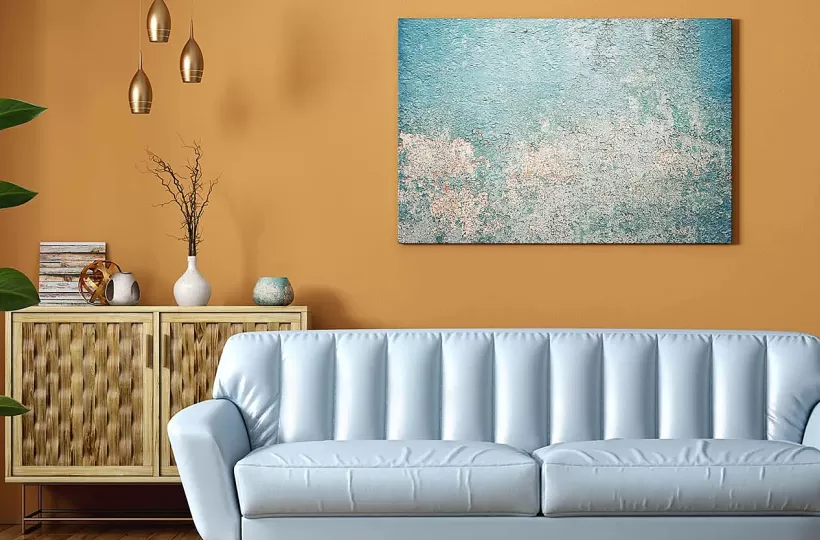
Textures are a welcome change to dull and flat walls. Linen drapes, a plush armchair, silk cushions, rattan furnishings, leather sofa and faux fur blanket, are elements that add different textures to the room and create a diversified setting. You can also choose to use texture paints to create patterns using one or more colours over the walls, can bring sophistication and style to the décor. There are plenty of texture paints and application techniques to choose amongst from fabrics/textiles, stucco, sand, popcorn and more, to add interest to your home décor effortlessly.
Declutter The Space
Too many attractive yet different pieces of furnishing and décor within one single room can clutter the space and confuse the onlooker. Too many chairs, stools, vases, and furnishing make a place feel disorganised and haphazard. Most designers recommend one large statement piece of furniture for even the smallest room, such as a cabinet or couch, which can be supplemented with a few well-chosen accessories that fit the room just right.
Accessorise
A glance at the work of the best interior designers will ensure you notice, the use of decorative tableware, bowls and wicker baskets, in an almost artistic way to add accessories to a room. Accessories in the accent colours can add a hint of glamour, for instance, a gold tray or candle holder, with a scented candle in the accent colour of choice. Although many times such accessories may seem frivolous, they are essential for a layered and ornate interior design scheme.
Accessorise
A Dash of Nature
Almost every designer décor scheme has flowers or plants in each room, including the restrooms. Merely adding a floral arrangement or indoor plant or even artificial plants in your home, can add a homely touch to your interior. If you cannot hire an interior designer yet desire a home that looks like it has been pulled from a magazine, these are the design ideas used by the most seasoned decorators.
A Dash of Nature
Create a warm, welcoming and well-decorated home, by adding colours, furniture, texture and a touch of nature to your interior décor.
Key Takeaways
Pick interior emulsions based on room use, washability and finish.
Surface preparation and primer decide how long paint lasts.
Use matte finishes for bedrooms and satin for high-traffic areas.
Plan interior wall paint colours as a connected whole-home scheme.
Accent walls, textures and stencils add design interest to interiors.
Painting cost depends on area, prep work and paint quality.
Nerolac Paints, a leading paint company in India offers a wide range of wall paint colours & painting services & solutions for homes & offices.
Best Colour Combination For Walls To Elevate Your Home Interiors
Looking for something else? Drop your query and we will contact you.
FAQs
Which paint is best for interior walls in India?
+
Water-based acrylic emulsions are the most common choice for Indian interiors because they are durable, low odour and quick drying. Premium emulsions offer better washability, stain resistance and smoother finishes, while economy emulsions suit rarely used rooms. For humid areas, choose anti-fungal properties. Nerolac interior emulsions are available across these performance ranges.
How do I paint my home interior?
+
Move and cover furniture, then clean walls and repair cracks with filler. Sand rough areas and apply a suitable primer. Paint the ceiling first, followed by walls, using a brush for edges and a roller for large areas. Apply two coats with adequate drying time between them, and finish with doors and trims.
What is interior design and how does painting fit in?
+
Interior design is the planning of indoor spaces to be functional, comfortable and visually pleasing, covering layout, furniture, lighting, materials and colour. Painting is one of its most powerful tools because wall colour sets mood and ties elements together. Designers use paint to highlight features, zone open spaces and make rooms appear larger or cosier.
What factors decide the cost of interior painting?
+
Costs depend on total wall area, number of coats, the condition of walls, and how much repair and putty work is needed. Paint quality and finish also matter, as do special effects like textures or stencils. Labour rates vary by city. Asking for an itemised estimate helps you compare quotes fairly and avoid surprises.
What do interior designers consider when choosing wall colours?
+
Designers look at natural light, room orientation, furniture and flooring, the room's purpose, and the desired mood. They consider undertones so colours harmonise across rooms. They also use contrast to highlight architecture, and lighter or darker shades to adjust perceived size. Practical factors like washability and maintenance guide finish selection.
What mistakes should I avoid in interior painting?
+
Avoid painting over damp or flaking walls, since the new coat will fail quickly. Don't skip primer on new plaster or patched areas. Choosing very glossy finishes for large walls highlights imperfections. Buying too little paint in one batch can cause slight colour differences. Always check coverage and plan enough quantity for two coats.
You will be redirected to a webpage/domain hosted by a third-party service provider (“Service Provider”) for limited purposes related to your interaction with Kansai Nerolac Paints.
Please note that while the Company’s logo may appear on the Service Provider’s page, it is not a Company-controlled page and is operated independently by the Service Provider.
On the Service Provider’s page, you will be provided with options for submitting your data, including uploading documents or providing information through various means.
While these options are enabled through a service provider, the Company does not endorse any specific option, and you are requested to choose independently and at your sole discretion.
Any actions taken on the Service Provider’s page, including the submission of data, shall be a matter between you and the Service Provider, and the Company will not be a party to this relationship.
You are responsible for the consent you provide on the Service Provider’s page, and any acceptance of terms beyond the purpose of use by the Company shall be deemed a contract between you and the Service Provider.
By providing your data through any of the available modes, you agree to share and disclose your information with the Company and the Service Provider for the purposes outlined above.
The Company may process, retain, and use the information as per its discretion.
For any modification, correction or erasure of the provided information, please raise you request by sending an email to dataprivacy@nerolac.com
Consent
In this Consent the following capitalized terms shall have the meanings assigned to them hereunder: By 'personal information' we mean names, addresses, email addresses, job experience and history and any other personal information you voluntarily provide about you and your skills and interests .“Data” shall mean all personal data, transactional data, Derivative Data, any other information, etc., in relation to me/us, including the following in relation to past Products:
By providing the consent you agree to providing your personal data which can be used by KNPL for the purposes mentioned hereafter and confirm that this consent is being given freely by you without any pressure, influence, or coercion from any other person, and that the consent is informed and unconditional.
Information submitted while making any application or request to the KNPL for any Product. Collection of information from personal correspondence (emails, letters) or third-party communications related to user activities on the website. Information may be used to offer products/services from the company and joint sponsors. Communicate with customers about orders, products, services, and promotional offers. Enhance and personalize the shopping and viewing experience on the website.
Additional information collected during transactions includes billing address, payment instrument details, and tracking information, handling orders, delivering products/services, and processing payments.
Information from messages or feedback provided by users is collected and retained for dispute resolution and customer support.
any information obtained/received by KNPL from any other source.
Collection of demographic and other data for advertising and promotional purposes. It can be used to show relevant content and customer reviews, suggest merchandise and services of interest, Improve the website and prevent/detect fraud or abuse, enable third parties to perform technical or logistical functions on behalf of the company.
We may share your personal information with vendors or service providers such as companies who help us with database administration. We may also share your personal information with other Kansai Nerolac companies in other countries where data privacy laws may not be equivalent to those in force in India.
any Derivative Data.
DEFINITIONS
“Derivative Data” shall mean any insights, analytics, performance metrics, behavioural projections, customer profiling, and reports (prepared by the Company internally or by third parties) that are generated through the analysis of data collected from customers, sales transactions, market research, and other relevant sources. This includes, but is not limited to, colour preference trends, purchase frequency, customer demographics, product usage patterns, and feedback analysis. Derivative Data may also include predictive analytics regarding future buying behaviour, inventory optimization, and market demand forecasts, whether derived from the information collected from customers or in combination with any other information sourced from external databases, market research firms, or other entities, whether by the Company or other persons. The process of arriving at and generating such Derivative Data through any of the above sub-processes/methods shall be referred to as “Derivation”.
“Specified Purposes” shall collectively mean the collection of personal data for various essential functions, including customer identification and verification to ensure eligibility for services or promotions, processing and fulfilling orders accurately, and enhancing customer engagement through tailored marketing campaigns and personalized offers. The data will also be utilized for monitoring sales trends and inventory management to optimize stock availability, providing customer support and service to address inquiries and resolve issues, and gathering feedback for product improvement and innovation. Additionally, the company will conduct market research and analysis to understand trends and customer preferences, implement risk assessment measures to detect and prevent fraud, and ensure compliance with legal obligations, including data protection and consumer rights. Personal data will support the management of loyalty programs and promotions, enhance the digital experience on the website through personalization, and facilitate data sharing with third-party partners for operational efficiency. Furthermore, the company will collect data for sustainability and environmental reporting, engage in necessary legal and regulatory compliance activities, and utilize analytics to monitor website performance and overall business effectiveness. aggregators, payment gateways, payments systems, performance of any legal and/or regulatory obligations, filings, reporting, etc., whether any of these are undertaken internally or through any Processing Entity.
"Processing” shall mean any operation or set of operations performed on Data, and includes operations such as collection, recording, organisation, structuring, storage, adaptation, retrieval, use, alignment or combination, indexing, sharing, disclosure by transmission, dissemination or otherwise making available, restriction, erasure or destruction and the term “Process” and “Processed” shall be construed accordingly.
“Processing Entity” shall mean any third party company(ies), bureau(s), consultant(s), vendor(s), agent(s), fintech entity(ies), co-brand entity(ies)/partner(s), distributor(s), selling/ marketing agent(s), any partner(s), collaborator(s), merchant(s), aggregator(s), lead generator(s), sourcing entity(ies), client(s), customer(s) or other person(s) with whom the KNPL has any direct or indirect arrangement or tie-up or contract for any products or services/ intermediary(ies) in any ecosystem of which KNPL is a part, and such Processing Entities’ service providers, consultants, vendors, etc.
“Product(s)” shall mean all types of paint and related products offered by the Company, including but not limited to topcoat, under coat, interior and exterior paints, primers, sealants, varnishes, specialty coatings, tools and ancillaries, wood finishes and construction chemicals. This definition encompasses products sold directly through the Company’s online platform, as well as those distributed through authorized dealers, retailers, contractors or other third-party vendors. The Products may also include complementary items such as paintbrushes, rollers, paint trays, and other application tools, as well as services related to colour consultation, custom mixing, and professional painting services. The Products that have been applied for, requested, or purchased by me/us (including where the initiation of any transaction is not directly with the Company but is with a relevant distributor or retailer) shall be referred to as “Requested Products,” while any Products (including future offerings) other than the Requested Products shall be referred to as “Other Products.”
CONSENT
I hereby authorize Kansai Nerolac Paints Limited (“Company”) to process my personal data (“Data”) or any part thereof for any of the Specified Purposes:
SPECIFIED PURPOSE
In connection with the assessment or processing of my application/request for any Requested Product, or to take any steps prior to entering into any contract, or to determine eligibility for the Requested Products, or in connection with the execution or furtherance of a contract/transaction, including performance by the Company or me/us or any other intermediaries, of any contract or part thereof, or any regulatory or legal obligations in relation to any Requested Product availed or in pursuance thereof;
In connection with the derivation and sharing of any derivative data (between the Company and any processing entity) related to the purposes.
In connection with contacting me, establishing communication, and monitoring my interactions through email, postal address, telephone, social media, notifications, and other electronic.
PURPOSES
I authorize the Processing Entities to process my Data or any part thereof for any of the Specified Purposes.
For the purposes covered above, it shall be deemed that I have furnished all the Data separately under this consent.
I confirm that the Data provided and that will be provided by me from time to time is accurate, updated, and complete in all respects.
I agree that the consents/authorizations for the Specified Purposes shall survive beyond the validity of such application/tenure of the Product/consummation of any transaction, to the extent any of the Specified Purposes survive.
The consents given or denied under this document do not limit any other consents obtained or given.
I acknowledge and confirm that all the Specified Purposes are lawful purposes.
I understand and agree that the processing of Data is necessary for the Specified Purposes.
I acknowledge that the request for consent or my giving of this consent does not limit or prejudice any grounds or bases that the Company or any Processing Entities may have for processing the Data without consent. This consent is in addition to any such grounds or bases. For clarity, even if this consent is withdrawn, the Company and/or the Processing Entities may continue to process the Data for the performance of contracts related to the Requested Products or for taking any steps pursuant to the contract or for protecting the legitimate interests of the Company.
I acknowledge that since this consent is the basis for the Company to enter a contract related to the Requested Products, it is necessary to process the Data for the purposes of the contract. Withdrawal of this consent will not prevent the Company and/or Processing Entities from continuing to process the Data for the purposes of the contract.
















 Get in Touch
 Download App

