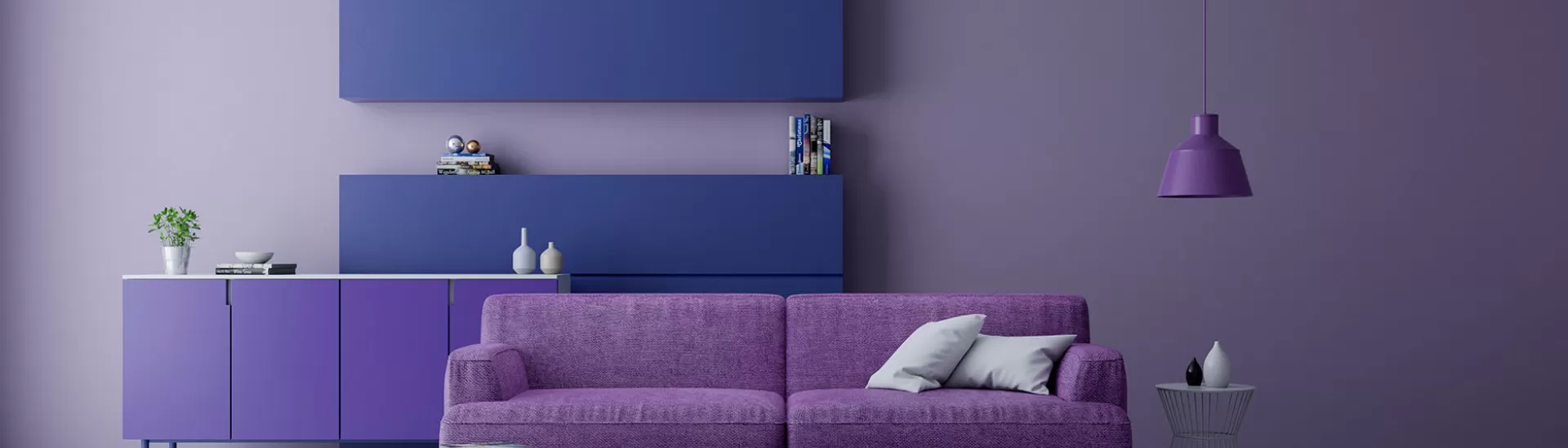
Violet is a vibrant colour that reflects spirituality, luxury, royalty, and imagination. You see it on a mood board or in a beautifully shot interior. It's not as neutral as grey, not as obvious as navy, not as subtle as white. Violet falls in its own category: deeply personal, quietly artistic, and surprisingly versatile when you understand how it works.
People reach for violet when they want a room that feels genuinely different. A violet wall in a bedroom changes the entire atmosphere of the space. It shifts how the light reflects, how the furniture looks and how the room makes you feel at the end of a long day.
Understanding the different types of violet colour, and knowing how to work with violet - whether you're mixing it yourself or selecting a ready-made shade - gives you real creative control over your space.
Violet Colour Composition
Violet is a secondary colour made from two primary colours- blue and red. Blue adds the coolness and depth; red brings in the warmth and intensity. The balance between them determines whether the violet is cool and moody or warm and expressive. Shifting that balance even slightly produces an entirely different violet colour shade and a different emotional quality on the wall.
What Colours Make Violet?
● Violet comes between blue and red on the colour wheel, which makes it a secondary colour.
● Both blue and red are primaries, and violet is what happens when they combine. On the opposite side of the colour wheel falls yellow - violet's complementary colour.
● A small addition of yellow will mute and neutralise violet quickly, which is useful when you want a dustier, more complex tone.
How to Make Violet Colour
Knowing how to make violet colour starts with having the right base colours and adding them incrementally. Here's the step-by-step process:
- Start with a clean mixing surface - Any residual colour from previous mixing will affect your violet, especially given how tonally sensitive this colour is.
- Choose a cool red - Crimson or magenta works far better than scarlet or orange-red, which pushes the mix towards brown rather than a clean violet colour.
- Choose a pure blue - Ultramarine blue is ideal; it has enough warmth to blend well with red without making the mix too cold.
- Begin with equal parts of both - This gives you a starting violet to work from; assess its character before adjusting.
- Adjust gradually - If you want to know how do you make violet colour that is cooler, add small amounts of blue; for a warmer tone, add slightly more red.
Also Read: Trending Bedroom Colour Ideas & Designs
What Two Colours Make Violet Colour?
Different red and blue combinations produce meaningfully different violets. If you're exploring how to make violet colour by mixing two colours, here's how the pairings work:
|
Complementary Pair
|
Tone Produced
|
|
Crimson Red + Ultramarine Blue
|
True, balanced violet
|
|
Magenta + Cobalt Blue
|
Bright, slightly warm violet
|
|
Scarlet Red + Prussian Blue
|
Deep, muted violet - leans toward plum
|
|
Pink + Indigo
|
Soft, lavender-adjacent light violet
|
|
Burgundy + Cerulean Blue
|
Earthy, red-dominated dark violet
|
How to Make Violet Colour by Mixing Two Colours
When you're working on how to make violet colour by mixing two colours for wall paint, ratios matter as much as the colour choice. Here's how different proportions behave:
|
Ratio (Red : Blue)
|
Dominant Colour
|
Result
|
|
50:50
|
Equal parts
|
True, balanced violet
|
|
60:40
|
More red
|
Warm, reddish-violet tone
|
|
40:60
|
More blue
|
Cool, blue-leaning violet
|
|
70:30
|
Heavy red
|
Deep berry or wine-violet
|
|
30:70
|
Heavy blue
|
Near-indigo, moody cool violet
|
How to Make Light Violet Colour
Light violet colour shades come from adding white colour into your base violet gradually. The rule is patiently adding white in small amounts, mixing completely, then assessing before adding more. The goal is to achieve a light violet colour that still appears clearly as violet - soft and open, but not so diluted that it disappears into pink colour or grey.
How to Make Dark Violet Colour
To create a dark violet colour, add small amounts of black or dark blue to your base violet. Black is the more aggressive of the two, so dark blue is often the better choice for maintaining depth and richness in a dark violet colour result. Add either in very small proportions, mixing fully between each addition.
● Renaissance Dream - A deeply saturated violet with an almost painted quality.
● Extraordinary - This is the shade for rooms where you want violet to own the walls.
● Flights of Fancy - A slightly softer dark violet with a dreamlike, artistic quality.
● Maroon Purple - A warm, red-dominant dark violet.
How to Adjust Violet Colour Tone
A mixed or chosen violet can be steered in three directions once you have the base, and each produces a different quality on the wall.
● Warm violet - Add a touch more red, or a trace of orange-red. This shifts the violet toward berry, mauve, or warm wine tones.
● Cool violet - Add a little more blue, or a trace of grey. Cool violet tones are more restrained, soft, and thoughtful.
● Muted violet - Add a very small amount of yellow colour to reduce the saturation. This creates a dusty, complex tone that feels artful rather than bright or bold.
Also Read: Two Colour Combination for Bedroom Walls
Popular Violet Shades in Nerolac Paints Colour Catalogue
Nerolac's violet range runs from barely-there lavenders to deeply saturated jewel tones, with several interesting mid-tones in between.
Just Imagine
A soft, dreamy violet that falls at the lighter end of the spectrum. Just Imagine colour feels optimistic and airy without being too pale to make an impact on the wall.
Ting Ting
A playful, mid-tone violet with warmth in it. Ting Ting colour more lively than a cool violet but not overtly bold - a strong choice for children's rooms and creative spaces.
Spanish Song
A warmer violet with a slightly rosy undertone. Spanish Song colour is rich and characterful, it brings a distinctly Mediterranean warmth to walls.
Maroon Purple
Maroon Purple colour shade falls at the intersection of violet and deep red, making it one of the more unique and versatile entries in the range.
Plum Tree
A dark, nature-inspired violet that carries organic richness. Plum Tree colour is excellent for feature walls in rooms with warm lighting.
Secret Boudoir
Secret Boudoir colour is Deep, intimate, and luxurious - for rooms that are meant to be private and enveloping.
Flowing Gown
A mid-depth violet with a slightly cool, elegant quality. Flowing Gown colour moves gracefully between formal and relaxed, depending on the surrounding decor.
Renaissance Dream
A saturated, jewel-toned violet that rewards good lighting. Renaissance Dream colour is well-lit room, it has an almost luminous quality that sets it apart from flatter shades.
Ready-Made Violet Colour Options
Mixing violet yourself is a rewarding exercise for art projects, but for wall painting, pre-mixed shades offer practical advantages that are hard to argue with:
● Batch consistency: Pre-mixed paints maintain an identical tone across every litre; critical when you're covering large wall surfaces where any variation shows.
● Finish accuracy: Ready-made shades are formulated for specific finishes and wall performance, not just colour appearance.
● Time and effort saved: No test batches, no ratio adjustments mid-project, no second-guessing at the mixing stage.
These four Nerolac shades are ready-to-use choices for violet walls:
● Plum Tree
● Secret Boudoir
● Flowing Gown
● Renaissance Dream
Nerolac's Colour Visualiser tool enables you to preview each violet colour shade on the walls under real lighting conditions.
Why Violet Colour Looks Different on Walls
You chose the shade carefully. It looked perfect in the catalogue. Then it went on the wall and looked entirely different. Here’s why it happens:
● Lighting - Violet is one of the most light-sensitive colours on the spectrum. Warm bulbs pull it towards red and pink. Cool lighting makes it bluer and more saturated.
● Surface texture - Rough or uneven walls create micro-shadows across the surface, making violet appear darker in recessed areas and lighter on raised ones.
● Paint finish - Matte finishes absorb light and make violet feel deeper and more velvety. Satin and gloss finishes reflect light, making the same violet appear brighter and more saturated.
Also Read: Best Holiday Colour Ideas - Schemes and Design Ideas
Common Mistakes to Avoid When Mixing Violet Colour
● Adding too much of one colour at once - Violet is easily unbalanced. Too much blue and it shifts into indigo. Too much red and it becomes magenta or maroon.
● Incorrect ratios - If you need to remix partway through a project, matching the original by eye is extremely difficult. Measure your ratios from the start.
● Skipping the wall test - Paper and mixing trays dry differently from wall surfaces. A test patch on the actual wall, dried fully and assessed in both natural and artificial light, is the only way to know what you're actually getting before committing to full application.
Mixing Violet Colour for Wall Paint vs Wall Art
For wall paint, consistency and volume are the priorities. Large surfaces expose any tonal variation between batches immediately. Mix everything you need in a single session, in properly measured quantities, and err on the side of mixing more rather than less.
For wall art and canvas work, the rules are more forgiving and the creative possibilities more interesting. Violet is a remarkably expressive colour in art contexts - it shifts character depending on what's near it on the canvas, deepens beautifully when glazed over, and interacts with warm colours like gold and orange in ways that feel almost electric.
Where to Use Violet Colour
Violet is adaptable across more room types than most people expect - the key is matching the shade depth to the room's size and light levels.
|
Room
|
Best Violet Shade
|
Placement
|
|
Living Room
|
Renaissance Dream, Maroon Purple
|
Feature wall or full room with neutral furniture
|
|
Bedroom
|
Flowing Gown, Just Imagine
|
All walls or accent walls for a restful atmosphere
|
|
Kitchen
|
Ting Ting, Spanish Song
|
Single-wall or lower cabinets
|
|
Balcony
|
Plum Tree, Secret Boudoir
|
Full wall or border trim
|
Violet Wall Colour Combinations for Your Home
● Violet and Purple - A tonal pairing that works when handled with care. Use a lighter violet alongside a deeper purple colour to create layered depth rather than visual competition.
● Violet and Peach – Peach colour brings warmth that softens violet's cooler qualities, and the combination has a light, almost floral freshness to it.
● Violet and Gold - One of the most classically elegant pairings available. Gold colour introduces warmth that makes violet walls feel rich and considered rather than cold.
● Violet and Pink - A two colour combination that skews warm and romantic. Soft blush pinks alongside a warm violet create a space that feels feminine and expressive without being overwhelming.
Also Read: 6 Wall Colour Shades for Your Home to Help You Relax
How Nerolac Paint Can Help Your Walls with Violet Colour
Getting violet right on a wall is genuinely harder than it looks. The colour is tonally complex, highly reactive to light, and has to be applied more evenly than a mid-tone neutral colours would be. Nerolac's professional painting service addresses all of this systematically.
Our team begins with an on-site assessment - looking at the room's dimensions, how natural light enters and moves through the space throughout the day, and what the room is actually used for. For violet shades especially, a deep jewel tone that works in a large, south-facing living room walls can feel oppressive in a small bedroom with minimal windows. Getting that recommendation right before any paint goes on the wall prevents costly mistakes.
Visualise Your Perfect Violet Shade with Nerolac Tools
Before you commit to a shade, it helps to see it, compare it, and know how much of it you'll need. Nerolac makes all three steps simple with a set of tools designed specifically for that process.
Colour Visualiser
Not sure how dark violet will look in your living room? Nerolac's Colour Visualiser lets you digitally apply any shade to a space to see it in context. It takes the guesswork out of colour decisions entirely.
Colour Catalogue
You can also browse the full range of violet colour shades organised by tone and finish. The Colour Catalogue makes it easy to compare shades side by side before shortlisting.
Paint Budget Calculator
Once the shade is locked in, the next question is always how much paint to actually buy. Nerolac's Paint Budget Calculator works that out for you and gives you a realistic figure. It's a small step that saves you from both the frustration of running short mid-wall and the waste of buying three extra litres you'll never use.




 Get in Touch
 Download App
