Grey is a subtle, achromatic shade that represents sophistication, neutrality, calmness, and balance. However, this unique shade gets misunderstood constantly. People call it safe, call it boring, or some even say that it is the colour you choose when you can't decide on a real colour. But spend time in a well-painted grey room, and that argument collapses completely.
Grey is one of the most complex, responsive colours you can put on a wall. It picks up warmth from timber floors, depth from dark furniture and freshness from white trim. It changes character entirely depending on the light coming through your windows.
This guide will help you understand how to make grey colour and identify areas where this colour suits the best.
Grey Colour Composition
Grey is produced by mixing black and white together, or by combining two complementary colours - like orange colour and blue, or red and green, in roughly equal amounts, which neutralise each other and produce a grey. The ratio of black to white determines the value of the grey. Any additional tint, such as blue, brown, or green colour, determines whether the grey colour shade appears warm, cool, or neutral colours.
What Colours Make Grey?
- The most direct answer is black and white. Together, they produce a neutral grey, which is a specific shade depending entirely on the ratio between them.
- Grey can also emerge from mixing complementary colours. Orange and blue colour in roughly equal quantities neutralise each other and produce a grey-brown. Red colour and green do the same. Purple colour and yellow mixed together create a muted grey-brown tone.
- The complementary-pair greys tend to be warmer and more complex than a straight black-and-white mix. They carry traces of the colours that made them, which is why they appear differently on a wall.
How to Make Grey Colour
Knowing how to make grey colour properly is mostly about understanding that the mixing sequence and proportions determine everything.
- Start with white as your base - Adding black into white gives you far more control than adding white into black; small additions go a long way in this direction.
- Add black in very small increments - Grey is one of the easiest colours to overshoot; a small amount of black produces a noticeable shift, so add it gradually.
- Decide on your undertone - If you want to know how do you make grey colour with warmth, add a tiny touch of raw umber or yellow colour ochre; for a cooler grey, add a trace of blue or violet.
- Test on the actual wall in natural daylight - Grey shifts more dramatically under different lighting conditions than almost any other colour. Do a wall patch test in real conditions to see the effects in natural daylight.
Also Read: Grey Paint Colour Shades and Contrast Combinations
What Two Colours Make Grey Colour?
When exploring how to make grey colour by mixing two colours, here's how different pairings behave:
|
Complementary Pair
|
Tone Produced
|
|
Black + White
|
True, neutral grey with a clean and balanced look
|
|
Orange + Blue
|
Warm, earthy grey with noticeable depth
|
|
Red + Green
|
Soft, dusty grey with a gentle warmth
|
|
Purple + Yellow
|
Subtle, complex grey with a slightly warm feel
|
|
Blue + White + Black (trace)
|
Crisp, cool grey with a contemporary touch
|
How to Make Grey Colour by Mixing Two Colours
For wall paint purposes, ratios determine whether your grey feels airy and pale or deep and anchoring.
|
Ratio (White: Black)
|
Dominant Colour
|
Result
|
|
95:5
|
White dominant
|
Very light grey, almost white
|
|
90:10
|
White dominant
|
Soft, classic light grey colour
|
|
80:20
|
White dominant
|
Mid-light grey with clear character
|
How to Make Light Grey Colour
Light grey colour is all about keeping white dominant and adding black in the smallest possible increments. The process needs patience; add black gradually, mix each time, and assess in natural daylight before deciding to add more.
How to Make Dark Grey Colour
To deepen grey, add black gradually - always mixing fully between additions. The risk with dark grey is losing warmth and ending up with something that reads as flat or near-black rather than a rich, characterful dark tone. Adding a trace of brown colour or blue alongside the black can maintain depth while preventing the grey from going dead.
- Tough Grey - A strong, deeply saturated grey
- Taupe Grey - A warm dark grey with a brown undertone
- Stunning Grey - A deep, jewel-quality grey
- Solitary Grey - A cool, contemplative dark grey
How to Adjust Grey Colour Tone
Once you have your grey base, you can steer the tone in many directions.
- Warm grey - Add a trace of raw umber, yellow ochre, or brown. This shifts grey toward taupe and greige territory - warm, inviting tones that feel comfortable and human rather than cold and clinical.
- Cool grey - Add a trace of blue or violet colour. Cool greys feel crisp, modern, and clean. They suit kitchens, bathrooms, and contemporary spaces where precision and restraint are the aesthetic goals.
- Muted grey - This is already grey's default state, but a more complex muted grey can be achieved by using complementary colour pairs rather than black and white alone.
Also Read: Trendy Grey Colour Combinations for a Stylish Interior
Popular Grey Shades in Nerolac Paints Colour Catalogue
Nerolac's grey range is genuinely comprehensive. The most popular shades to look for are -
Tough Grey
Tough Grey colour is a deep, assertive grey that anchors a room without softening itself for the occasion.
Taupe Grey
Taupe Grey colour and brown undertone makes this a grey that feels genuinely comfortable to live with - not cold, not stark, just deeply liveable.
Stunning Grey
Stunning Grey colour is a saturated, jewel-toned mid-dark grey with a richness that rewards good lighting. In a well-lit room, this shade has an almost metallic depth.
Solitary Grey
Solitary Grey colour shade leans slightly blue-grey and has a considered, composed quality that suits spaces meant for quiet focus.
Mute Grey
Mute Grey colour is muted, restrained grey that sits confidently in the background. Versatile and reliable across almost any room type.
Metal Grey
A cooler, more industrial grey with a precise, contemporary quality. Metal Grey colour works beautifully in modern kitchens, bathrooms, and open-plan living room walls.
Magnum Grey
Magnum Grey Colour shade sits close to charcoal territory while maintaining enough lightness to remain a grey rather than a near-black.
Grey's Lily
Grey's Lily colour is softer, more feminine grey with a floral undertone. Subtle and elegant, this is the grey for spaces where restraint is the entire point.
Ready-Made Grey Colour Options
Mixing grey yourself works well for smaller projects where variation is acceptable. For painting walls, pre-mixed shades offer advantages that are hard to replicate through DIY mixing:
- Tonal consistency - Factory-mixed grey paints maintain the exact same tone; any variation in a DIY grey mix becomes immediately visible across large wall surfaces.
- Undertone control - Getting the warm-cool balance right in a DIY grey is genuinely difficult.
- Application performance - Ready-made paints are formulated for proper adhesion, coverage, and finish consistency on wall surfaces.
These four Nerolac shades are good choices:
1. Mute Grey
2. Metal Grey
3. Magnum Grey
4. Grey's Lily
Before purchasing, use Nerolac's Colour Visualiser tool to get an idea of how the colour will look on your walls.
Why Grey Colour Looks Different on Walls
Grey is arguably the single most light-reactive colour you can choose for a wall. The same shade can look completely different across different rooms, different times of day, and different lighting types.
- Lighting - Always assess your chosen grey colour shade under your room's actual lighting conditions before committing.
- Surface texture - A smooth, well-prepared wall gives grey the evenness it needs to appear correctly.
- Paint finish - The same grey in two different finishes can look like two different colours in practice.
Also Read: Grey House Colour Schemes for Your Exterior Walls
Common Mistakes to Avoid When Mixing Grey Colour
- Adding too much black too quickly - Black is the most aggressive modifier in any mix. Add black one drop at a time, every time.
- Not accounting for undertones - A grey that looks perfectly neutral in the mixing tray can reveal unexpected warm or cool undertones once it's dried on a wall under real lighting.
- Skipping the wall test - Proper patch test on the actual wall is non-negotiable before full application. Make sure the wall is dry fully and assessed at different times of day.
Mixing Grey Colour for Wall Paint vs Wall Art
Grey is particularly sensitive to batch variation - even small differences in the black-to-white ratio produce visible tonal shifts across large surfaces. Mix the full quantity needed in a single session, measure your ratios precisely, and keep any leftover paint for touch-up work.
For wall art and canvas work, grey is one of the most useful and expressive colours in a painter's colour palette.
Where to Use Grey Colour
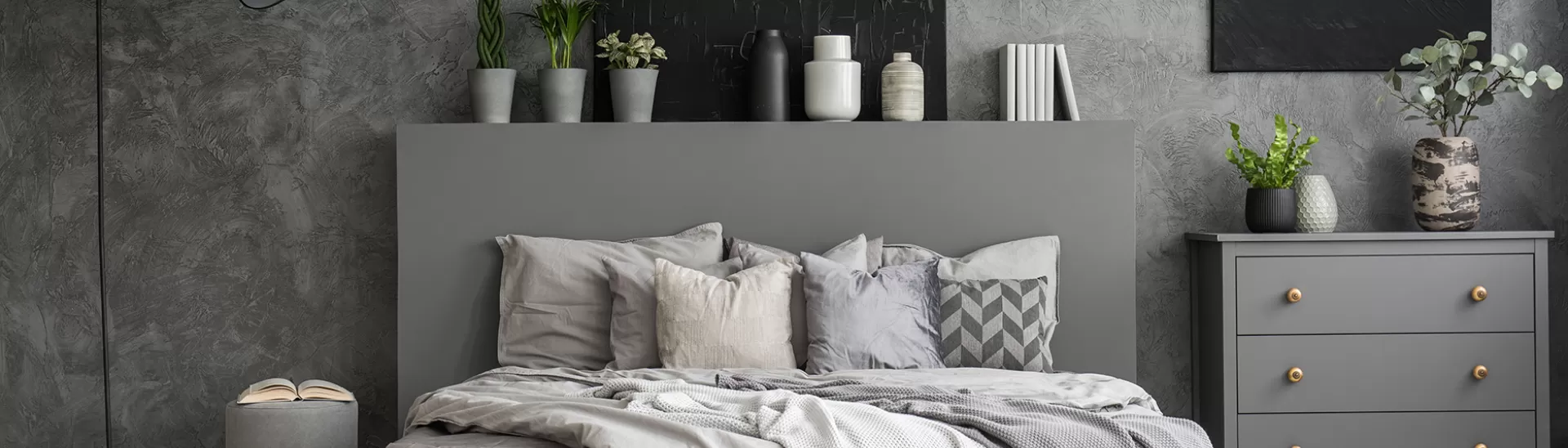
Grey's adaptability is genuinely unmatched; it suits every room in the house when the right shade and finish are matched to the space.
|
Room
|
Best Grey Shade
|
Placement
|
|
Living Room
|
Tough Grey, Magnum Grey
|
Feature wall or full room with warm or neutral furnishings
|
|
Bedroom
|
Solitary Grey, Grey's Lily
|
All walls or accent walls for a calm, restful atmosphere
|
|
Kitchen
|
Metal Grey, Mute Grey
|
Full room, lower cabinets, or backsplash wall
|
|
Balcony
|
Taupe Grey, Stunning Grey
|
Full wall or border trim that holds character in outdoor light
|
Grey Wall Colour Combinations for Your Home
- Grey and Pink - One of the most enduringly popular pairings in contemporary interior walls. Blush or dusty pink colour softens grey's potential coldness and creates a two colour combination that feels warm and layered.
- Grey and Yellow - A high-energy pairing that works when the yellow is warm and mustard-toned rather than bright and primary. Mustard yellow colour against a cool mid-grey creates contrast that feels both modern and grounded.
- Grey and Violet- Violet and deep grey have a natural affinity that feels organic and deeply contemporary. Both colours belong to the same tonal family, thoughtful and a little moody. Together, they create spaces that feel genuinely designed.
- Grey and Blue - A blue feature wall alongside lighter grey surrounding walls creates depth and dimension without colour contrast.
Also Read: Best Accent Wall Colours To Pair With Grey
How Nerolac Paint Can Help Your Walls with Grey Colour
Grey is a demanding colour when it comes to getting it painted correctly on a wall. Its sensitivity to lighting and undertone means the difference between a beautiful grey room and a disappointing one often comes down to the assessment and application process rather than the shade selection alone.
Nerolac's professional painting service approaches each grey project with a thorough room evaluation before any paint goes on. Surface preparation is taken seriously across every project, with thorough priming and levelling carried out before topcoat application.
For types of grey colour, especially, any unevenness in the base layer creates visible tonal inconsistency once the paint is dry. The application is then handled with a calibrated technique to maintain consistent colour density across the full wall.
Visualise Your Perfect Grey Shade with Nerolac Tools
Before you commit to a shade, it helps to see it, compare it, and know how much of it you'll need. Nerolac makes all three steps simple with a set of tools designed specifically for that process.
Colour Visualiser
Not sure how dark grey will look in your living room? Nerolac's Colour Visualiser lets you digitally apply any shade to a space to see it in context. It takes the guesswork out of colour decisions entirely.
Colour Catalogue
You can also browse the full range of grey colour shades organised by tone and finish. The Colour Catalogue makes it easy to compare shades side by side before shortlisting.
Paint Budget Calculator
Once the shade is locked in, the next question is always how much paint to actually buy. Nerolac's Paint Budget Calculator works that out for you and gives you a realistic figure. It's a small step that saves you from both the frustration of running short mid-wall and the waste of buying three extra litres you'll never use.








 Get in Touch
 Download App
