Bathroom Paint Colour - 7 Ideas for Different Types of Bathrooms
Bathroom Paint Colour - 7 Ideas for Different Types of Bathrooms
Published: 23 Sep 2019 |
Modified: 11 Aug 2026
HomeWall Paint
Bathroom Paint Colour - 7 Ideas for Different Types of Bathrooms
Quick Summary
To make brown colour by mixing two colours, combine complementary colours such as red and green, blue and orange, or yellow and purple. The exact shade of brown depends on the proportion of each colour used. Lighter browns can be created by adding white, while deeper browns can be achieved by increasing the darker colour. This guide explains simple paint-mixing techniques, colour adjustments, and practical tips for creating custom brown shades for walls, furniture, and home decor projects.
Create Your Dream Home With Our Painting Experts
Fill the form below to book a free site evaluation by Nerolac Nxtgen painting Services expert
TABLE OF CONTENTS
Bathroom - a place perfect for unwinding after a hectic day or taking a splash when days go blue. For such a wonderful part of your house where you can be yourself, you need bathroom colours that look wonderful and don't tame your vibe. Thought white is the best bathroom paint colour? Or are you planning to make the simpler (and not-so-great) pick with artistic tiles? Get out of your comfort zone and try one of these bathroom colour ideas to transform your bathroom for awesomeness.
Try These Bathroom Colour Ideas to Transform Your Bathroom
Bathroom Paint Colour With Bejewelled Emerald
Bathroom Paint Colour With Bejewelled Emerald
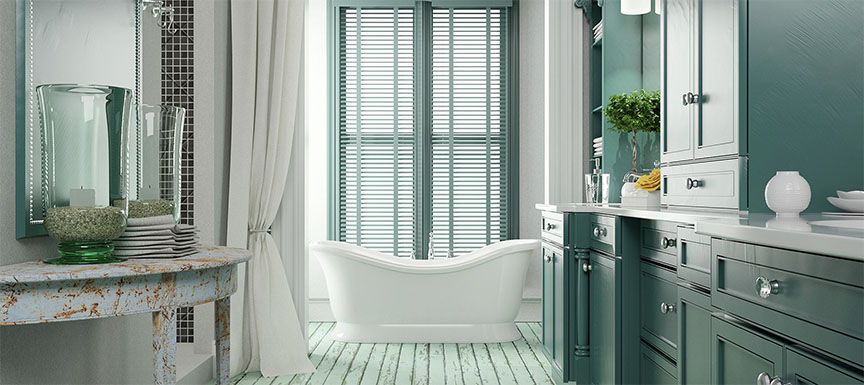
If you were trying to make your bathroom look classy and posh with vintage-styled jewels or copper fittings, the ideal backdrop should be a deep emerald shade. A bathroom wall colour tone like Le Mer (2476) is made for stylish bathrooms of all sizes. Metallic and yellowish lights, stone or metallic bathtub and basin, and copper or brass-like plumbing fixtures create an alluring decor that can mesmerise your senses every time.
Bathroom Paint Colour With Gorgeous Graphite
Bathroom Paint Colour With Gorgeous Graphite
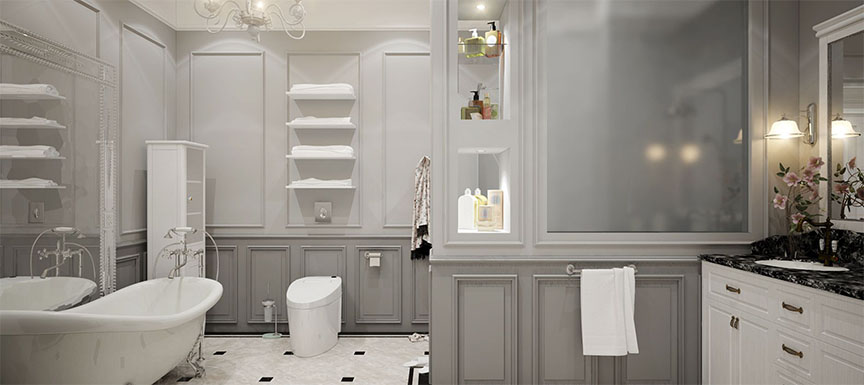
If your bathroom faces the north and doesn't get a lot of light, you need a bathroom paint colour that can reflect light and illuminate the space. Our suggestion - muted grey! This light yet gorgeous tone looks lovely with all kinds of bathroom decor, especially the spacious ones. But if you wish to create a beautiful bathroom, you need to pair this bathroom paint with white sanitary ware and fittings. And don't forget to add several lights and lamps. That's how you'll light up your dark bathroom.
Bathroom Paint Colour With Dreamy Snow
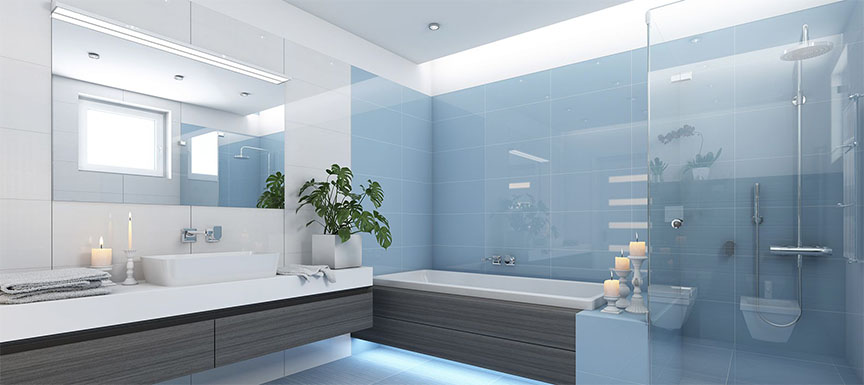
When you don't like your spacious bathroom to look cluttered at all, you need a pretty bathroom colour combination because the colours, too, contribute to the overall look. For the bathroom wall colour, choose something delicate but flamboyant, something like a pastel blue. Blue Tonic (4250) is meant for minimalistic and spacious bathrooms. Whether or not your bathroom receives natural light, this colour will brighten up the bathroom gracefully.
Bathroom Paint Colour With Sunkissed Deeps
Bathroom Paint Colour With Sunkissed Deeps
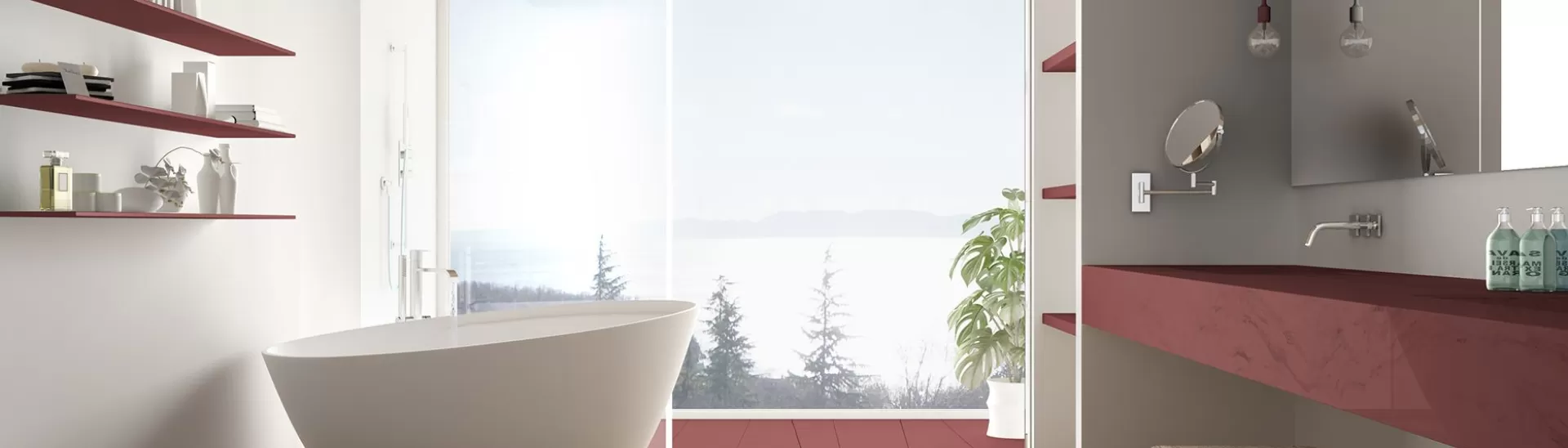
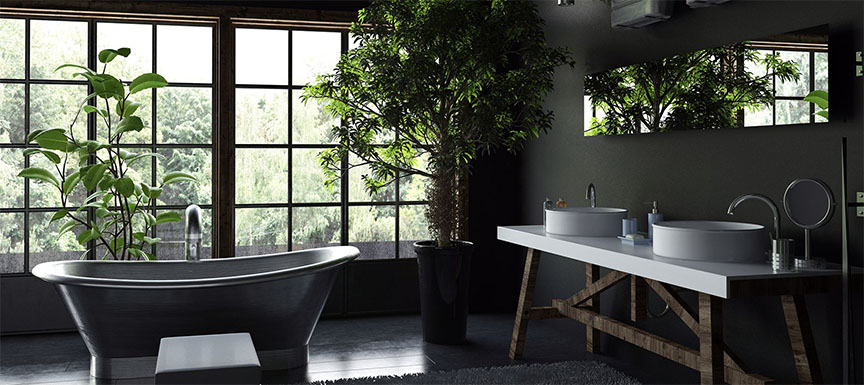
Dark and deep wall colours are making their way to bathrooms from living rooms and bedrooms. So experiment with something unusual, something exciting. If you have a large window facing the shower or bathtub, dark bathroom colours will compliment and balance the brightness. Pure white fixtures, marble flooring, and high ceiling painting with a very deep hue together create a welcoming bathroom colour combination. Still not sure which colour to pick? Dark grey, cobalt blue, deep sea green, or extreme violet can be some bathroom paint ideas.
Bathroom Paint Colour With Earthy Balance
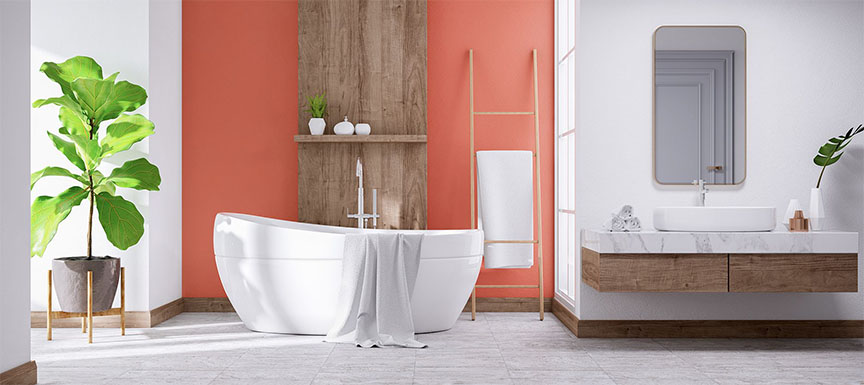
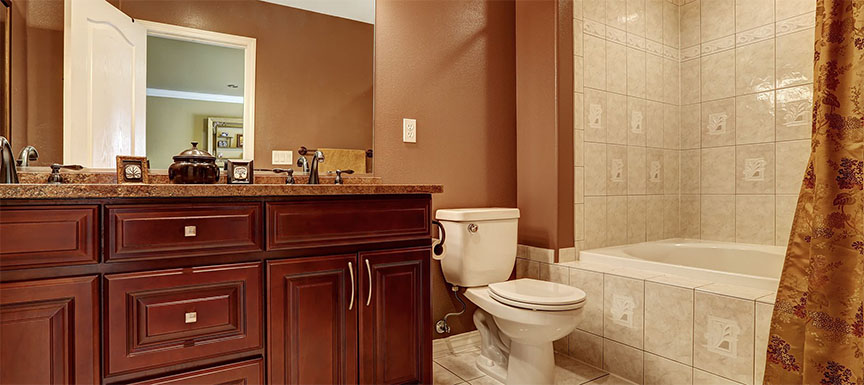
Want traditionally rich or rustic decor in your bathroom? Do you already have wooden flooring with a few wooden windows? Don't think twice, and simply pick a rich brown bathroom paint. Brown bathroom colour continues its surge in popularity for well-lit or shaded bathrooms. Tall tower candles, a wooden bench, glass divider, and metallic fittings create a breath taking bathroom experience. And if that's too much brown for your bathroom, add another colour element by painting an accent wall with a lighter brown bathroom colour.
Bathroom Paint Colour With Delicate Enchantress
Bathroom Paint Colour With Delicate Enchantress
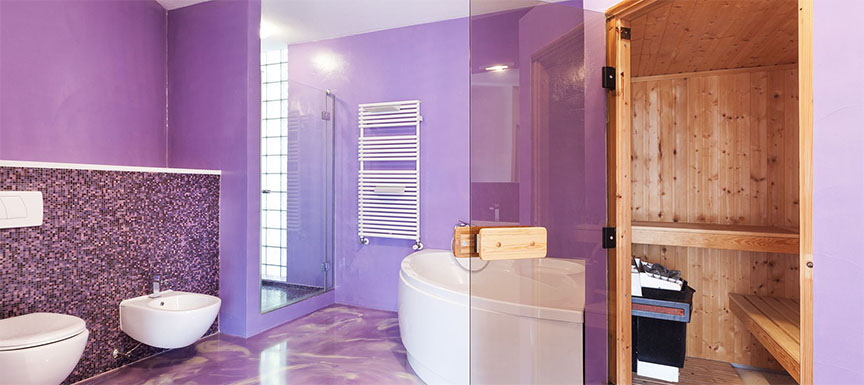
Not into the bold, vibrant bathroom colours? Try a more subdued hue like lavender. This pretty and space-enhancing bathroom paint colours is right for small bathrooms with too much to fit in. When paired with all-white fixtures and wares, you'll get a tranquil space to rewind and freshen up. Keep the accessories, lights, and bathroom fabrics in white too, so as not to overwhelm the space with too much purple. This bathroom wall colour is apt to add the right amount of colour to the room, while still keeping it neutral and muted. We love how these bathroom colour ideas can give different types of bathrooms an instant facelift. But apart from these colours, you must also consider which bathroom paint you choose. Look for paint and finish that will be able to withstand moisture, splashes, and soap. You can pick our Pearls Emulsion range the colour is known for its excellent washability, something that your bathroom paint needs to have so that it doesn't wash away with time.
Key Takeaways
Brown colour can be made by mixing two complementary colours such as red and green, blue and orange, or yellow and purple.
The ratio of colours determines whether the brown appears warm, cool, light, or dark.
Adding white creates lighter brown shades such as beige, tan, or cream-brown tones.
Increasing the darker colour produces richer brown shades suitable for wood finishes and accent walls.
Testing small paint swatches before applying the final mixture helps achieve the desired brown colour accurately.
Custom brown shades work well for wall paint, wooden furniture colour, decorative accents, and DIY home decor projects.
Nerolac Paints, a leading paint company in India offers a wide range of wall paint colours & painting services & solutions for homes & offices.
Best Colour Combination For Walls To Elevate Your Home Interiors
Looking for something else? Drop your query and we will contact you.
FAQs
Which two colours make the warmest brown shade?
+
A warm brown is easiest to create by mixing red and green, with slightly more red in the mixture. This combination produces earthy brown tones that work well for wooden furniture colour, rustic decor, and warm wall accents. You can further soften the shade by adding a small amount of white or yellow paint.
How do you make light brown colour for wall painting?
+
To create a light brown shade, first mix a basic brown using complementary colours, then gradually add white paint until you reach the desired tone. This method is ideal for creating beige, tan, or soft coffee shades that are commonly used in modern home interiors and neutral wall colour schemes.
Can you make dark brown colour without using black paint?
+
Yes. Dark brown can be achieved by increasing the amount of blue, purple, or dark red in your brown mixture. Adding black paint can sometimes make the colour look flat, while deepening the complementary colours produces a richer and more natural-looking brown suitable for furniture and accent walls.
What is the easiest way to make brown colour with primary colours?
+
The simplest method is to mix red, blue, and yellow together in roughly equal proportions. This creates a neutral brown base that can be adjusted warmer with more red or yellow, or cooler with more blue. It is a useful technique for artists, DIY decorators, and paint-mixing beginners.
How can I make brown paint look more natural for wooden furniture?
+
For a natural wood-like finish, start with a warm brown base and add a small amount of yellow ochre or burnt sienna if available. Avoid overly bright primary colours, and test the mixture on a scrap surface first. Layering slightly different brown tones can also create a more realistic wood-grain appearance.
Which brown shades work best for modern home interiors?
+
Modern interiors usually look best with taupe brown, walnut brown, mocha brown, and soft greige-brown shades. These colours pair well with white, grey, beige, and muted green palettes, making them suitable for walls, cabinetry, wooden furniture colour updates, and contemporary living spaces.
You will be redirected to a webpage/domain hosted by a third-party service provider (“Service Provider”) for limited purposes related to your interaction with Kansai Nerolac Paints.
Please note that while the Company’s logo may appear on the Service Provider’s page, it is not a Company-controlled page and is operated independently by the Service Provider.
On the Service Provider’s page, you will be provided with options for submitting your data, including uploading documents or providing information through various means.
While these options are enabled through a service provider, the Company does not endorse any specific option, and you are requested to choose independently and at your sole discretion.
Any actions taken on the Service Provider’s page, including the submission of data, shall be a matter between you and the Service Provider, and the Company will not be a party to this relationship.
You are responsible for the consent you provide on the Service Provider’s page, and any acceptance of terms beyond the purpose of use by the Company shall be deemed a contract between you and the Service Provider.
By providing your data through any of the available modes, you agree to share and disclose your information with the Company and the Service Provider for the purposes outlined above.
The Company may process, retain, and use the information as per its discretion.
For any modification, correction or erasure of the provided information, please raise you request by sending an email to dataprivacy@nerolac.com
Consent
In this Consent the following capitalized terms shall have the meanings assigned to them hereunder: By 'personal information' we mean names, addresses, email addresses, job experience and history and any other personal information you voluntarily provide about you and your skills and interests .“Data” shall mean all personal data, transactional data, Derivative Data, any other information, etc., in relation to me/us, including the following in relation to past Products:
By providing the consent you agree to providing your personal data which can be used by KNPL for the purposes mentioned hereafter and confirm that this consent is being given freely by you without any pressure, influence, or coercion from any other person, and that the consent is informed and unconditional.
Information submitted while making any application or request to the KNPL for any Product. Collection of information from personal correspondence (emails, letters) or third-party communications related to user activities on the website. Information may be used to offer products/services from the company and joint sponsors. Communicate with customers about orders, products, services, and promotional offers. Enhance and personalize the shopping and viewing experience on the website.
Additional information collected during transactions includes billing address, payment instrument details, and tracking information, handling orders, delivering products/services, and processing payments.
Information from messages or feedback provided by users is collected and retained for dispute resolution and customer support.
any information obtained/received by KNPL from any other source.
Collection of demographic and other data for advertising and promotional purposes. It can be used to show relevant content and customer reviews, suggest merchandise and services of interest, Improve the website and prevent/detect fraud or abuse, enable third parties to perform technical or logistical functions on behalf of the company.
We may share your personal information with vendors or service providers such as companies who help us with database administration. We may also share your personal information with other Kansai Nerolac companies in other countries where data privacy laws may not be equivalent to those in force in India.
any Derivative Data.
DEFINITIONS
“Derivative Data” shall mean any insights, analytics, performance metrics, behavioural projections, customer profiling, and reports (prepared by the Company internally or by third parties) that are generated through the analysis of data collected from customers, sales transactions, market research, and other relevant sources. This includes, but is not limited to, colour preference trends, purchase frequency, customer demographics, product usage patterns, and feedback analysis. Derivative Data may also include predictive analytics regarding future buying behaviour, inventory optimization, and market demand forecasts, whether derived from the information collected from customers or in combination with any other information sourced from external databases, market research firms, or other entities, whether by the Company or other persons. The process of arriving at and generating such Derivative Data through any of the above sub-processes/methods shall be referred to as “Derivation”.
“Specified Purposes” shall collectively mean the collection of personal data for various essential functions, including customer identification and verification to ensure eligibility for services or promotions, processing and fulfilling orders accurately, and enhancing customer engagement through tailored marketing campaigns and personalized offers. The data will also be utilized for monitoring sales trends and inventory management to optimize stock availability, providing customer support and service to address inquiries and resolve issues, and gathering feedback for product improvement and innovation. Additionally, the company will conduct market research and analysis to understand trends and customer preferences, implement risk assessment measures to detect and prevent fraud, and ensure compliance with legal obligations, including data protection and consumer rights. Personal data will support the management of loyalty programs and promotions, enhance the digital experience on the website through personalization, and facilitate data sharing with third-party partners for operational efficiency. Furthermore, the company will collect data for sustainability and environmental reporting, engage in necessary legal and regulatory compliance activities, and utilize analytics to monitor website performance and overall business effectiveness. aggregators, payment gateways, payments systems, performance of any legal and/or regulatory obligations, filings, reporting, etc., whether any of these are undertaken internally or through any Processing Entity.
"Processing” shall mean any operation or set of operations performed on Data, and includes operations such as collection, recording, organisation, structuring, storage, adaptation, retrieval, use, alignment or combination, indexing, sharing, disclosure by transmission, dissemination or otherwise making available, restriction, erasure or destruction and the term “Process” and “Processed” shall be construed accordingly.
“Processing Entity” shall mean any third party company(ies), bureau(s), consultant(s), vendor(s), agent(s), fintech entity(ies), co-brand entity(ies)/partner(s), distributor(s), selling/ marketing agent(s), any partner(s), collaborator(s), merchant(s), aggregator(s), lead generator(s), sourcing entity(ies), client(s), customer(s) or other person(s) with whom the KNPL has any direct or indirect arrangement or tie-up or contract for any products or services/ intermediary(ies) in any ecosystem of which KNPL is a part, and such Processing Entities’ service providers, consultants, vendors, etc.
“Product(s)” shall mean all types of paint and related products offered by the Company, including but not limited to topcoat, under coat, interior and exterior paints, primers, sealants, varnishes, specialty coatings, tools and ancillaries, wood finishes and construction chemicals. This definition encompasses products sold directly through the Company’s online platform, as well as those distributed through authorized dealers, retailers, contractors or other third-party vendors. The Products may also include complementary items such as paintbrushes, rollers, paint trays, and other application tools, as well as services related to colour consultation, custom mixing, and professional painting services. The Products that have been applied for, requested, or purchased by me/us (including where the initiation of any transaction is not directly with the Company but is with a relevant distributor or retailer) shall be referred to as “Requested Products,” while any Products (including future offerings) other than the Requested Products shall be referred to as “Other Products.”
CONSENT
I hereby authorize Kansai Nerolac Paints Limited (“Company”) to process my personal data (“Data”) or any part thereof for any of the Specified Purposes:
SPECIFIED PURPOSE
In connection with the assessment or processing of my application/request for any Requested Product, or to take any steps prior to entering into any contract, or to determine eligibility for the Requested Products, or in connection with the execution or furtherance of a contract/transaction, including performance by the Company or me/us or any other intermediaries, of any contract or part thereof, or any regulatory or legal obligations in relation to any Requested Product availed or in pursuance thereof;
In connection with the derivation and sharing of any derivative data (between the Company and any processing entity) related to the purposes.
In connection with contacting me, establishing communication, and monitoring my interactions through email, postal address, telephone, social media, notifications, and other electronic.
PURPOSES
I authorize the Processing Entities to process my Data or any part thereof for any of the Specified Purposes.
For the purposes covered above, it shall be deemed that I have furnished all the Data separately under this consent.
I confirm that the Data provided and that will be provided by me from time to time is accurate, updated, and complete in all respects.
I agree that the consents/authorizations for the Specified Purposes shall survive beyond the validity of such application/tenure of the Product/consummation of any transaction, to the extent any of the Specified Purposes survive.
The consents given or denied under this document do not limit any other consents obtained or given.
I acknowledge and confirm that all the Specified Purposes are lawful purposes.
I understand and agree that the processing of Data is necessary for the Specified Purposes.
I acknowledge that the request for consent or my giving of this consent does not limit or prejudice any grounds or bases that the Company or any Processing Entities may have for processing the Data without consent. This consent is in addition to any such grounds or bases. For clarity, even if this consent is withdrawn, the Company and/or the Processing Entities may continue to process the Data for the performance of contracts related to the Requested Products or for taking any steps pursuant to the contract or for protecting the legitimate interests of the Company.
I acknowledge that since this consent is the basis for the Company to enter a contract related to the Requested Products, it is necessary to process the Data for the purposes of the contract. Withdrawal of this consent will not prevent the Company and/or Processing Entities from continuing to process the Data for the purposes of the contract.












 Get in Touch
 Download App
